
5-gallon or roughly 15–25 kg pails
Useful for trials and smaller manufacturing runs. Depending on the supplier, these may be available as frozen or other appropriate puree configurations.
Bulk asparagus puree is a savory vegetable ingredient for manufacturers requiring characteristic asparagus flavor, natural vegetable solids, controlled fiber and a smooth-to-moderately textured consistency. It is used in soups, sauces, culinary bases, prepared foods, baby food, dips, fillings and plant-based formulations. PFVN supports industrial buyers with technical specifications, conventional and organic sourcing options, packaging, documentation and commercial supply programs.
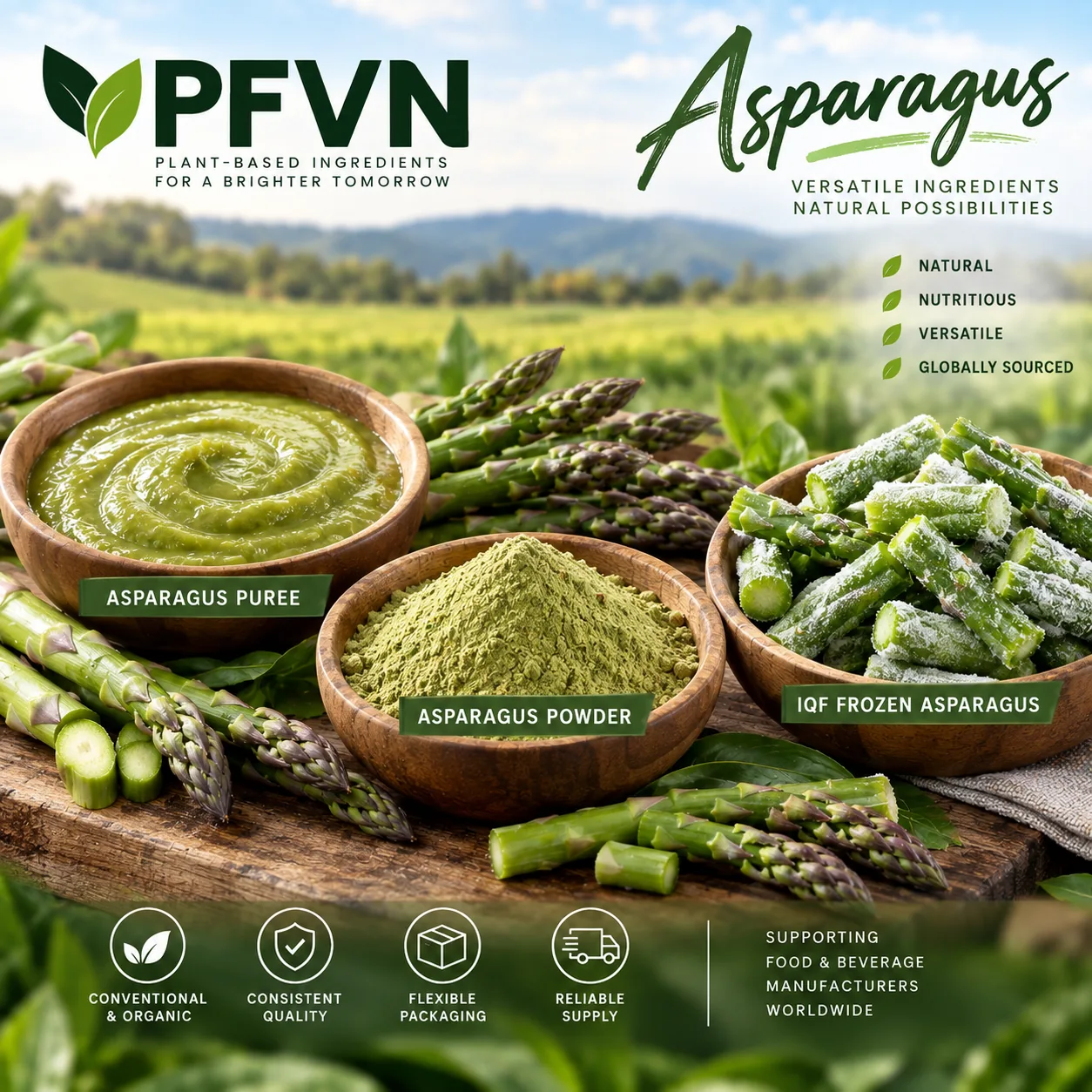
Commercial asparagus is derived from Asparagus officinalis, a perennial vegetable crop harvested for its young shoots or spears. Green and white asparagus come from the same species: green spears develop chlorophyll after exposure to light, while white asparagus is traditionally grown without light exposure to maintain its pale appearance.
For green asparagus puree, spear maturity is particularly important. Young spears have a tender structure, while advancing maturity and post-harvest hardening can increase fibrousness toward the lower portions of the spear. Raw-material grading, trimming and refining therefore influence the texture and fiber profile of commercial puree.
Asparagus has a distinctive savory, green-vegetable flavor and relatively low natural soluble-solids content compared with many fruit purees. Its value in formulation comes primarily from characteristic vegetable identity, color, moisture, suspended vegetable solids and flavor rather than sweetness.
Commercial asparagus puree can reduce the preparation required when using whole asparagus by providing a processed vegetable ingredient that has already been cleaned, size-reduced and refined. Depending on the source, production may include blanching or other thermal treatment before milling, sieving, pasteurization and commercial packing.
Puree provides recognizable asparagus flavor throughout a formulation and can be used either as the principal vegetable component or in combination with potato, leek, spinach, peas, herbs, dairy ingredients or plant-based systems.
Green asparagus puree contributes natural green-to-olive coloration. Raw material maturity, blanching, heat treatment, pH, oxygen exposure and storage can all influence the finished color.
The puree contains suspended vegetable material that contributes body and mouthfeel. Refining conditions are especially important because asparagus spears naturally contain fibrous structural material.
Puree distributes asparagus flavor and solids more uniformly than cut pieces, making it useful for smooth soups, sauces, fillings, dips and blended prepared foods.
There is no single universal specification for commercial asparagus puree. Actual analytical values depend on raw material, processing method and supplier. The following parameters are commonly evaluated during industrial qualification.
Asparagus naturally has substantially lower soluble solids than many fruit ingredients. One published commercial aseptic puree specification lists approximately 2.8–4°Brix as an example. Buyers should use the actual supplier specification rather than treating this range as universal.
Asparagus is a low-acid vegetable ingredient. A published commercial puree reference lists approximately pH 5.5–6.8, illustrating why pH and the supplier's validated preservation process are important qualification points. Customer process requirements should be defined separately.
Screen size determines the amount and size of retained fibrous material. A commercial reference specification uses approximately a 0.8 mm screen, but finer or different finishes may be required for smooth soups, sauces or specialized formulations.
Consistency affects pumping, mixing, depositing and final texture. Commercial specifications may use Bostwick or another viscosity method; one published aseptic reference reports approximately 11–22 cm per 30 seconds. Results should only be compared using equivalent test conditions.
Color should be characteristic of the processed asparagus type. For green asparagus, chlorophyll degradation during heating and storage can shift color from brighter green toward more muted green or olive tones.
Commercial qualification should confirm recognizable asparagus character and the absence of fermented, scorched, oxidized, excessively fibrous or other objectionable sensory characteristics.
Specifications may establish limits for aerobic plate count, yeast and mold, coliforms and relevant pathogens. Required limits depend on processing method, packaging, storage conditions and intended use.
Buyers should confirm whether the offered puree is 100% asparagus or whether salt, acidulants, processing aids or other ingredients are present. Composition should match formulation and labeling requirements.
Asparagus differs from soft fruit purees because its spear structure naturally contains longitudinal fibers. Trimming, cooking, milling and screening therefore have a direct effect on mouthfeel and processing performance. A puree acceptable for a chunky culinary soup may not provide the finish required for a smooth cream sauce or baby-food formulation.
Thermal treatment can soften plant tissue and improve processability, but heat also influences green color and volatile flavor compounds. Product-development trials should reproduce the manufacturer's actual heating conditions where color or delicate asparagus character is important.
When puree is blended with starches, gums, dairy components, fats or plant proteins, these ingredients can substantially alter apparent viscosity and flavor release. Final consistency should therefore be evaluated in the finished formula rather than from puree viscosity alone.
Asparagus puree is principally used in savory manufacturing systems where processors require uniform vegetable flavor, controlled fiber and a smooth vegetable base. The most important applications include soups, sauces, prepared meals, baby food, fillings, dips and plant-based formulations.
A primary application for asparagus puree. It is used in cream-of-asparagus soups, vegetable bisques, soup concentrates and culinary bases where uniform flavor and smooth vegetable solids are required.
Application guide → Sauces Sauces & CondimentsPuree can form part of cream sauces, pasta sauces, vegetable sauces, savory dressings and cooking sauces where asparagus flavor and vegetable body need to be distributed uniformly.
Application guide → Infant foods Baby Food ManufacturingFinely refined asparagus puree may be used in vegetable or mixed baby-food formulations subject to the manufacturer's particle-size, ingredient, microbiological and process specifications.
Application guide → Plant-based Plant-Based Food FormulationAsparagus puree can contribute vegetable identity, moisture and solids to plant-based sauces, fillings, soups, spreads and prepared-food components.
Application guide → Prepared foods Prepared Foods & Ready MealsApplications include refrigerated and frozen meals, pasta fillings, vegetable side dishes, grain-based meals and other products requiring controlled distribution of asparagus throughout the formulation.
Application guide → Savory Dips & SpreadsPuree can be blended with dairy or plant-based bases, herbs, garlic, oils and other vegetables to produce spreads, dips and savory appetizer formulations.
Application guide →A smooth puree format also allows asparagus to be incorporated into products where whole pieces would create inconsistent distribution, handling or portioning.
Asparagus puree can be combined with cheese, dairy alternatives, potato, starches or seasonings for ravioli, stuffed pasta, pastry and other savory filling systems.
Puree can be incorporated into savory breads, dough systems, vegetable muffins and baked fillings where asparagus flavor and vegetable content are desired.
Puree can support frozen soups, sauces, side dishes and prepared-meal components. Freeze-thaw stability should be evaluated in the actual finished formulation.
Bulk puree can provide a convenient asparagus base for centralized kitchens, foodservice sauce production and institutional soup or prepared-food programs.
Commercial asparagus puree can differ substantially in fibrousness, color, solids, consistency and flavor even when products have the same basic ingredient description. Comparing quotations therefore requires confirmation that the offered products meet similar technical requirements.
Raw-material maturity and the portion of the spear used can be important. Lower, more mature stem material may be more fibrous than tender spear sections, while refining intensity can change both yield and texture. Manufacturers with demanding smoothness requirements should establish sieve and sensory criteria before approving a source.
Conventional and certified-organic programs may be available depending on origin and supplier. Trial quantity, annual demand, required certification, delivery destination and preferred packaging should be provided early in the commercial inquiry.
Asparagus puree may be offered in aseptic or frozen industrial formats depending on the processor. Storage, handling and production planning should be based on the exact preservation process and package configuration being purchased.
Aseptically processed puree is thermally treated and packed in a sterile barrier system. Some commercial programs allow unopened ambient storage, but temperature recommendations and shelf life remain supplier-specific.
Frozen puree requires temperature-controlled storage and transportation. Manufacturers should plan freezer capacity, thawing procedure, production usage and post-thaw handling before selecting this format.
Receiving teams may verify lot identification, package integrity, net weight, product condition, temperature where relevant and required documentation before releasing product to production.
Pack size should align with batch volume so opened or thawed product can be used within the supplier's recommended handling period without unnecessary partial-pack storage.
Microbiological specifications depend on the puree's thermal process, package format, storage system and intended use. Commercial specifications may address total aerobic count, yeast and mold, coliforms and relevant pathogens. Customer-specific requirements should be communicated during qualification.
Physical criteria can include fiber content, coarse particles, foreign material, color variation and consistency. These parameters can be particularly important for smooth soups, sauces and baby-food applications where visible fibers or particles may affect product acceptance.
Because asparagus is an agricultural raw material, some natural variation in green color, flavor and solids should be expected. Commercial tolerance ranges should distinguish acceptable crop variation from characteristics that are critical to the finished product.
Puree performance depends on the complete formulation and manufacturing process. A product that appears relatively fluid by itself can become much thicker after interaction with starch, protein, gums or other vegetable solids. Likewise, color and flavor may change during pasteurization, retorting, refrigerated storage or freezing.
Pilot trials should reproduce the intended shear, heating, holding, cooling and storage conditions whenever texture or fresh asparagus character is commercially important.
Depending on the application, asparagus may also be sourced as IQF frozen pieces or powder when a recognizable vegetable piece, lower-moisture format or dry ingredient is more appropriate than puree.
Select package size around production batch volume, storage conditions, thawing or pumping requirements, line rate and unloading equipment. Exact packaging availability depends on the processor and commercial program.
Useful for trials and smaller manufacturing runs. Depending on the supplier, these may be available as frozen or other appropriate puree configurations.
A common industrial reference scale for puree supply. One published aseptic asparagus puree specification uses approximately 210 kg drums, while actual fill weight and liner configuration vary by supplier.
Potentially suitable for higher-volume pumpable programs where the puree, processing system and aseptic or refrigerated filling technology support bulk tote supply.
Selected puree programs may use smaller bag-in-box, lined-carton or frozen block configurations where manageable portions and easier thawing are preferred.
Include the application, sieve or texture requirement, target solids or consistency, pH requirement where relevant, color expectations, conventional or organic program, estimated quantity, preferred packaging, delivery location and timing. These details help identify an appropriate commercial source and specification.